



Different Types of Cosmetic Raw Materials You Need to Know
3 Comments
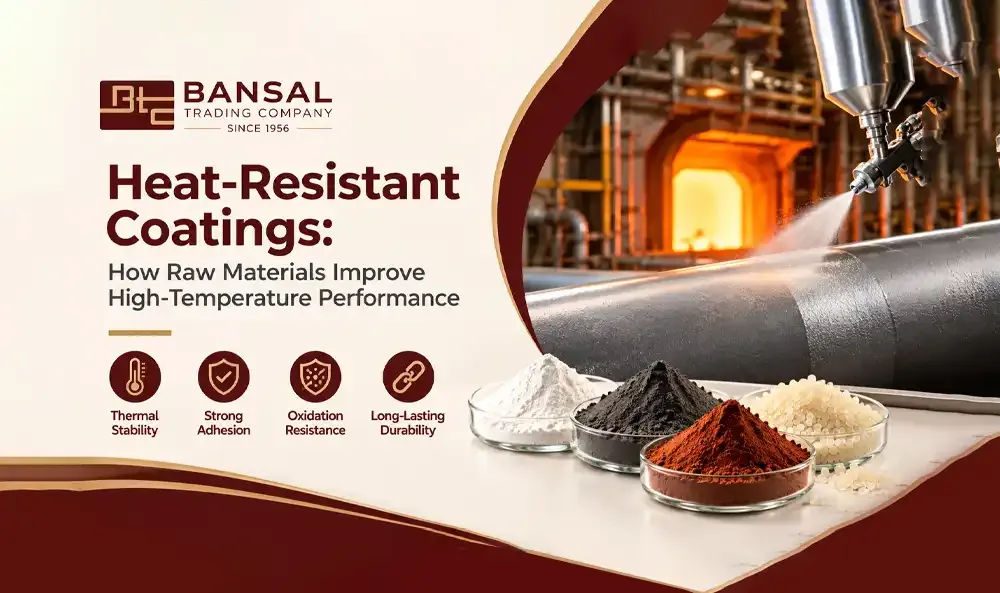
Heat resistant coatings improve their performance at high temperature by virtue of using special raw materials that help give the required thermal stability, adhesion, and durability of the coating. Bansal Trading Company is a provider of raw materials and chemicals based in Delhi, India and provides its services to customers based in India and abroad. We offer raw-materials solutions for industrial uses including paints & coatings helping manufacturers/formulators to procure raw materials according to their formulation needs.
Industrial equipment like furnaces, boilers, exhaust systems, and heat exchangers might be exposed to prolonged heat, thermal cycles and sudden temperature changes leading to cracking, peeling, discoloration, and loss of adhesion of conventional coatings. Through our product knowledge and supplier network, we support manufacturers in finding practical raw-material options for demanding coating applications.
Build coatings that perform under extreme heat with carefully selected paint raw material suppliers in Delhi.
Heat-resistant coatings are special types of protective coating systems which have been manufactured in such a way that they retain all their physical, chemical and protective properties despite the temperatures to which they are subjected. Depending on how they are made and the type of application they may either be capable of enduring continuous or intermittent exposure to heat.
The main difference between conventional industrial coatings and high-temperature coatings is the ability of the latter to endure thermal stress apart from being able to provide corrosion protection or having aesthetic or environmental resistance properties.
The distinction between continuous and intermittent exposure is particularly important. Since the same coating should endure different conditions, in case the coating is applied on the component operating constantly at high temperatures, compared to the one operating briefly in contact with heat and then cooling down.
A regular coating will become soft, decompose, discolor or lose its adhesion to the substrate because of the elevated temperatures beyond its capability. When the binder starts to break down, the film of the coating will become unstable and let the heat, oxygen, water and other elements get access to the surface.
A specialised heat-resistant coating approaches the problem differently. Its components are selected to maintain stability and structural integrity under the expected service conditions.
The binder or resin acts as the backbone of the coating film. It acts as a binding agent of the pigment and fillers as well as provides adhesion to the substrate. If the binder cannot withstand the operating temperature, even highly stable pigments and fillers cannot compensate for its failure.
Pigments can help in retaining color, opacity and thermal stability, whereas fillers can be used for strengthening the coating along with its barrier properties. The functional additives can help with dispersion, wetting, rheology, adhesion, film formation and surface properties.
Curing and film formation are equally important. A formulation with appropriate raw materials can still underperform if it is incorrectly applied, inadequately cured, or used outside its intended temperature range.
Key takeaway: Heat resistance is a property of the complete coating system, not simply one raw material.
The performance of the high temperature coating depends very much on how well the raw materials are interacting in the coating. There are four major classes: resins and binders, pigments, fillers, and functional additives.
Resins and binders comprise the major film of any high-temperature coating. They are responsible for the adhesion of other components, thermal stability, and durability. Silicone and modified silicone resins could be used when high-temperature resistance is required, whereas epoxy resin and other similar systems could be used in comparatively low-temperature conditions.
Heat-stable pigments provide colour, opacity and visual consistency while helping the coating withstand elevated temperatures. Iron oxides, titanium dioxide, aluminium pigments and other inorganic pigments may be selected according to the formulation. Their thermal stability is important for reducing discolouration and maintaining the coating’s appearance during heat exposure.
Fillers such as silica, mica and aluminosilicates can modify the coating’s physical and thermal properties. They may improve mechanical reinforcement, dimensional stability and barrier performance while helping optimise the formulation. The right filler, particle size and loading level can support coating durability without negatively affecting adhesion or film formation.
Functional additives can facilitate the process of coating manufacturing and provide additional functionality of the coating after its application. Depending on their chemical composition, they can affect dispersing, wetting, rheology, adhesion, film forming and surface properties. Selection of additives in heat resistant coatings is of particular importance since additives should remain compatible with the formulation and effective at high temperatures.
A heat-resistant coating raw materials is best understood as a coordinated system:
| Raw Material | Primary Role |
| Resin | Film formation and thermal stability |
| Pigments | Colour, opacity and thermal stability |
| Fillers | Reinforcement, dimensional stability and barrier properties |
| Additives | Processing, dispersion and performance modification |
The interaction of these components determines the behavior of the final coating. In other words, a thermally stable resin requires appropriate pigments and fillers to keep the composition stable. The proportion of pigment and filler content should be maintained to ensure the coating is mechanically stable and has good adhesion.
Material choice is an essential factor, however, it is not all there is to coating performance. There is more to the performance of a heat resistant coating that includes:
Consequently, a coating should always be evaluated against the complete operating environment rather than temperature alone in India.
High-temperature coatings are used in areas where components are exposed to engine heat and exhaust temperatures. Applications can include:
The formulation must account for both temperature and the mechanical or chemical conditions surrounding the component.
Industrial processing equipment can operate under sustained heat, making protective coatings important for service life and maintenance.
Common applications include:
Here, the coating may need to combine thermal stability with corrosion and chemical resistance.
Power-generation and energy infrastructure can expose coated surfaces to prolonged heat and environmental stress.
Applications may include:
The formulation requirements depend on operating temperature, fuel or process environment, substrate and maintenance conditions.
Metal-processing environments can involve extreme temperatures, thermal cycling and demanding mechanical conditions.
Heat-resistant coatings may be considered for:
In these applications, resistance to thermal shock and mechanical degradation can be as important as continuous temperature resistance.
| Parameter | Conventional Coatings | Heat-Resistant Coatings |
| Temperature tolerance | Limited to designed service range | Formulated for higher-temperature conditions |
| Binder selection | General-purpose systems | Specialised thermal-stability systems |
| Pigment selection | Broad selection based on appearance and performance | Greater emphasis on thermal stability |
| Thermal stability | Moderate depending on formulation | Specifically engineered for elevated temperatures |
| Thermal cycling | May have limited resistance | Designed around specific heating and cooling conditions |
| Applications | General industrial surfaces | High-temperature equipment and components |
| Formulation priorities | General protection and appearance | Thermal stability, adhesion and durability |
The distinction is therefore not simply about using a different paint. Heat-resistant coating systems require raw materials and formulation strategies designed around a more demanding service environment.
Bansal Trading Company caters to coating manufacturers and industrial formulators by offering chemical raw materials which are well-suited for various formulations in India. In heat-resistant coatings, right selection of raw materials makes a huge difference to the thermal stability, adhesion, durability and overall quality of the coating.
Whether it is heat-resistant resins & binders that contribute film integrity or heat stable pigments which ensure colour and thermal performance, each component has its own significance. Reinforcement and barrier properties can be delivered by fillers whereas functional additives can play important roles in optimizing dispersion, wetting, rheology and film formation.
Your next high-temperature coating starts with the right material choice.
A coating becomes heat resistant through a balanced formulation designed to withstand elevated temperatures without significant cracking, peeling, oxidation, or degradation. Resin chemistry, pigment stability, fillers, additives, curing and substrate compatibility all contribute to its high-temperature performance.
Common raw materials include silicone or silicone-modified resins, heat-stable pigments such as iron oxides and titanium dioxide, mineral fillers such as silica and mica, and functional additives. Their compatibility and proportions determine the coating’s thermal stability, adhesion and durability.
Silicone and silicone-modified resins are commonly used in high-temperature coating systems because of their thermal stability. Epoxy and other resin systems may be suitable for comparatively lower-temperature applications, depending on the required temperature range, adhesion, flexibility and environmental conditions.
Heat-stable pigments such as iron oxides, titanium dioxide, aluminium pigments and other inorganic pigments can be used in heat-resistant coatings. Selection depends on the required colour, opacity, thermal stability, UV resistance and compatibility with the chosen resin system.
Heat-resistant coatings use specially selected binders, pigments, fillers and additives to maintain film integrity under elevated temperatures. The binder holds the coating together and adheres to the substrate, while other components contribute thermal stability, reinforcement, barrier properties and surface performance.
Performance depends on operating temperature, exposure duration, thermal cycling, thermal shock, substrate type, surface preparation, coating thickness and curing conditions. Environmental exposure and corrosion requirements can also influence how effectively a coating performs during prolonged or repeated high-temperature service.
The terms are often used interchangeably, but high-temperature coating generally refers to a specialised coating system formulated for demanding elevated-temperature conditions. Heat-resistant paint may be a broader term, covering products designed to tolerate heat while providing protection and appearance.