



Different Types of Cosmetic Raw Materials You Need to Know
3 Comments
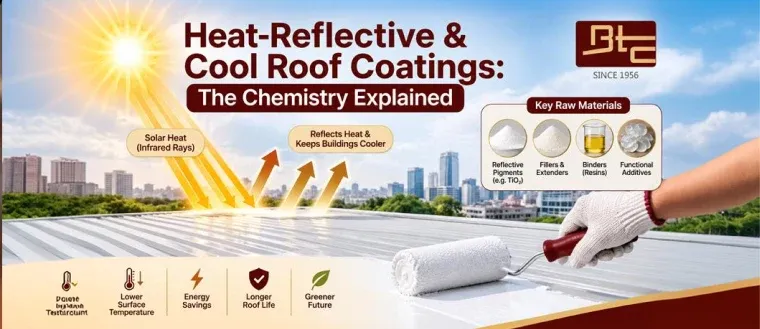
Roof coatings protect exposed surfaces but depend on the composition of their coating to manage solar heat. Bansal Trading Company offers products for the industrial buyer in PAN India, and internationally for raw material requirements for coating applications. Heat-reflective and cool roof coatings are becoming more important as the need increases to minimize solar heat gain for industrial facilities.
Their performance is dependent on the chemistry of the pigment used, binders and solar reflectance and thermal emittance. Consideration of the above will make it easier to select materials that satisfy the requirements of thermal performance, along with considerations of durability and adhesiveness. Nevertheless, even though reflective coatings will reduce solar heat absorption, they do not act as thermal insulators.
Enquire about advanced cool roof coatings designed with anti-corrosive pigments in paints and coatings to help reduce heat absorption.
Heat-Reflective coatings are designed in order to reflect solar radiation and minimize the energy absorbed by the surface. Cool roof coatings usually feature high reflectivity along with high thermal emittance to increase thermal efficiency of the roof.
Standard roof coatings are basically used for protection from water and other damaging effects whereas thermal-insulating coatings are developed to resist heat flow. A reflective coating does not imply that it is an insulating coating.
Key performance properties include:
When the radiation comes to a coated surface, some energy is reflected and the rest of energy is absorbed or, if applicable, transmitted. The heat absorption raises the surface temperature and the rest of the heat passes due to the transmission of heat from the substrate to the ambient air or via heat radiation.
The process is: Incoming solar radiation → Reflection and absorption → Heat generation → Heat dissipation.
Solar energy is characterised by the presence of ultraviolet (UV), visible and infrared rays. Usually, visible light accounts for the visible color of the coating, while near-infrared radiation plays an important role in the total energy absorption.
Formulation of the pigment influences the reflection and absorption capabilities of the coating. Titanium dioxide ensures the scattering of light in white coating formulations, while certain types of pigments provide the necessary infrared reflectance in other colored coatings. High solar reflectance means low absorbed heat while proper thermal emittance means that the heat can be easily released.
Solar reflectance measures the fraction of incoming solar energy reflected by a surface. A reflectance value of 0.80 represents approximately 80% reflection under the relevant measurement conditions.
It is influenced by pigment chemistry, particle size, the amount of pigment used and how it is dispersed throughout the coating. No matter how high the reflectance of a white pigment, the visible colour doesn’t necessarily correlate to solar performance. Still, even some dark-coloured pigments can be designed to reflect near-infrared radiation.
Thermal emittance relates to the effectiveness of a surface to emit thermal radiation relative to that of an ideal blackbody in the same conditions. A surface with a higher emittance will improve heat discharge from the coated surface.
Both properties matter when evaluating cool roof coatings. High reflectance limits solar heat absorption, while high emittance supports thermal radiation. Some rating systems combine these properties into a Solar Reflectance Index (SRI), which estimates surface temperature behaviour under specified conditions. SRI does not directly measure insulation.
Titanium dioxide brings about whiteness, opacity, and scattering of light rays. Special inorganic and NIR-reflective pigments can help in increasing the solar reflectivity and in meeting particular color requirements. Other factors to consider while selecting titanium dioxide pigments are optical properties, ability to disperse well, color preservation and stability against weathering.
Fillers affect the structure, characteristics and formulation costs of the coating. It is necessary to take into account the concentration and the properties of the particles in order to get the desired results. The use of the wrong filler may lead to unwanted effects like reduced reflectance values, porosity and loss of integrity of the coating.
Binders are crucial in holding the pigments and fillers together and in forming the coating film, as well as, in ensuring adhesion. The most popular binders in exterior paint raw materials are acrylics, while silicone-modified and other exterior-grade systems can be employed depending on the conditions of exposure. The right choice will depend on UV resistance, moisture resistance, flexibility, compatibility with the substrate and durability.
Dispersants, wetting agents, rheology modifiers, defoamers and adhesion promoters are needed for the production and the application of coatings. The compatibility of these substances with the other ingredients is very important for the successful coating application.
Although white coatings are usually highly reflective, colored coatings can perform well due to the presence of special NIR pigments, applied in their formulation. By combining these pigments with specific dark colors, coatings are able to absorb visible light and reflect large amounts of the near-infrared spectrum.
The effect of the concentration of the high-performance pigments, the size of their particles and the way they are dispersed into the binder on the reflectance and hiding properties of the coating should also be taken into consideration. It should be mentioned that too much pigment can either lower cohesion of the film or reduce its water resistance.
A coating’s colour alone does not reveal its complete heat-reflective capability.
| Property | Heat-Reflective Coating | Thermal-Insulating Coating |
| Primary mechanism | Reflects solar radiation | Reduces heat transfer |
| Main focus | Solar reflectance and emittance | Thermal resistance |
| Key formulation factors | Pigments and binder | Insulating materials and structure |
| Surface temperature | Can reduce solar heating | Depends on system design |
| Typical applications | Roofs and exposed surfaces | Thermal barrier applications |
Warehouses, manufacturing facilities, distribution centres and industrial sheds may use reflective coatings to reduce solar heat absorption across extensive roof areas.
Steel roofing, metal panels and industrial structures require suitable coatings that combine reflectance with adhesion, corrosion protection and weather resistance.
Tanks, storage structures and selected exposed equipment may benefit from reflective coatings where reduced solar heating aligns with operating requirements.
Large commercial buildings, utility structures and transport-related infrastructure can also be considered, provided the coating is compatible with the substrate and service environment.
Formulation chemistry alone cannot guarantee real-world performance. Substrate compatibility, surface preparation, coating thickness, application method and pigment dispersion all influence the finished film.
UV exposure, moisture, temperature cycling and industrial pollutants can contribute to degradation. Dust and dirt accumulation may reduce reflectance, while chalking and binder deterioration can alter surface properties. Therefore, initial reflectance should be considered alongside aged performance, maintenance requirements and expected service conditions.
Formulators and industrial buyers should evaluate the following factors before selecting heat resistant coatings raw materials ingredients:
Technical data, formulation trials, and appropriate testing help establish whether the selected materials meet the intended requirements.
Maintaining reflectance over time can be difficult when dirt pickup, pigment dispersion problems or weathering alter the coating surface. Formulators must also manage colour–reflectance trade-offs, UV degradation, chalking, moisture resistance and adhesion.
Poor pigment dispersion may create uneven optical performance, while incompatible additives can affect film formation or substrate bonding. Testing the complete formulation under relevant exposure conditions helps identify these issues before large-scale application.
Each ingredient contributes to the final coating system:
The goal is to balance reflectance, emittance, adhesion, durability and weatherability. A highly reflective pigment cannot compensate for a coating film that deteriorates quickly, so the complete formulation must be evaluated as a system.
The effectiveness of heat-reflecting roof coatings is determined by the appropriate blend of various pigments, binders, fillers, and additives. Bansal Trading Company satisfies industrial needs in PAN India, and beyond, engaging in discussions about the raw materials of the coating compositions.
The appropriate choice of materials and testing of their properties help the formulators to find the proper balance of multiple characteristics, in particular, the solar reflective ability, heat emissivity, compatibility with substrate, and durability of the performance.
The best formulation is a formulation providing a required scope of performance properties while ensuring dependable performance for the period of time expected for a certain product.
A heat-reflective coating uses specially selected pigments and compatible binders to reflect incoming solar radiation rather than absorb it. Its performance depends on solar reflectance, pigment dispersion, formulation quality and resistance to outdoor weathering.
Cool roof coatings reflect a significant proportion of incoming sunlight, reducing the solar energy absorbed by the roof. High thermal emittance also helps release absorbed heat, potentially lowering surface temperatures and reducing heat transfer indoors.
Heat-reflective coatings commonly use titanium dioxide, specialised inorganic pigments and near-infrared-reflective pigments. These materials influence solar reflectance, colour, opacity and weathering stability, making pigment selection important for achieving the required coating performance.
Solar reflectance measures the proportion of incoming solar energy reflected by a coated surface. Higher solar reflectance generally reduces heat absorption, helping limit surface heating under suitable environmental conditions and supporting cool roof performance.
Heat-reflective coatings reduce solar heat absorption by reflecting sunlight, while thermal-insulating coatings aim to resist heat transfer. Both technologies can complement each other when a building requires reduced solar heating and improved thermal resistance.
Yes, certain dark-coloured coatings use specialised near-infrared-reflective pigments to reflect infrared radiation while maintaining their visible colour. Their effectiveness depends on pigment chemistry, formulation compatibility and measured solar reflectance rather than appearance alone.
Cool roof coatings typically contain reflective pigments, resin binders, fillers and functional additives. These ingredients influence solar reflectance, thermal emittance, adhesion, film formation, application properties and resistance to UV radiation and moisture.
Titanium dioxide has a high refractive index and scatters visible light effectively, contributing to whiteness, opacity and reflectance in suitable formulations. Its overall contribution depends on pigment grade, dispersion, concentration and binder compatibility.
Cool roof coating performance depends on pigment selection, solar reflectance, thermal emittance, binder chemistry, substrate preparation and application thickness. UV exposure, moisture, dirt accumulation and weathering can also influence long-term durability and reflectance.
Bansal Trading Company serves businesses in PAN India, and worldwide, helping industrial buyers explore raw-material options for coating applications. Contact the company to discuss material specifications, formulation requirements and sourcing needs.